
- Home
- Future phones will run AI on the device—without internet processing
Future phones will run AI on the device—without internet processing
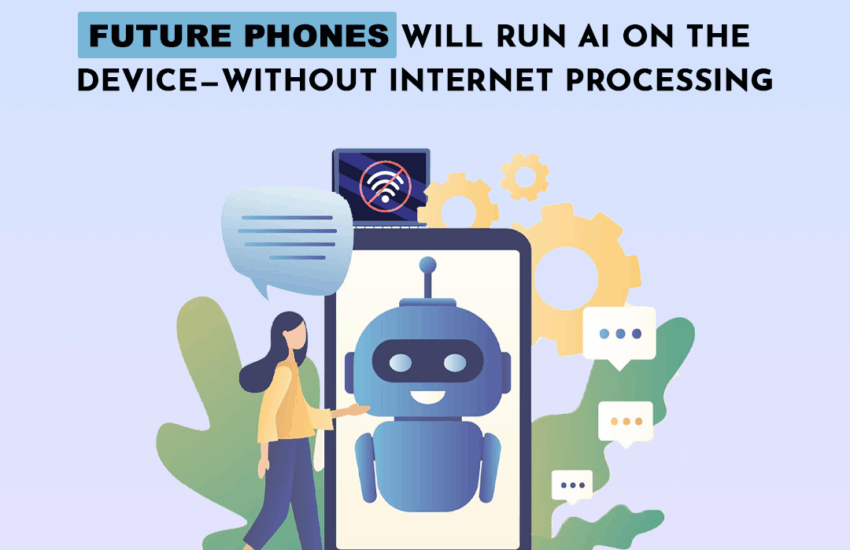
Smartphones are entering a new era where AI will no longer assist you through cloud web security but will live on during the interactions, offline, always protecting your personal data, and will be able to provide you with instant feedback. Until now, almost all of the AI-powered mobile apps’ features were dependent on cloud processing. The real-time translation, voice-to-AI functionality, and even image processing all depended upon powerful mega-computers located hundreds of miles away.
But the pace of change today is unmatched.
With the introduction of custom app development, tomorrow’s smartphones will be able to complete cutting-edge AI solution tasks.
This change will redefine the speed of interactions, level of privacy, overall performance of the smartphone, and the way users will communicate with their devices.
Why Is On-Device AI Becoming the Future?
What Cloud AI offered was new; however, the following aspects of Cloud AI were problematic:
- Requires high-speed internet access
- Experience significant lag due to delay from remote servers
- For the user, Cloud AI always raises significant privacy abuse concerns
- Significant battery drain on the device when remote servers are reached
- For companies that rely on remote servers, high operating costs
Smartphones built with powerful Neural Processing Units, AI Co-Processors, and Edge Computing devices avoid every single problem listed above.
1. What Exactly Is On-Device AI?
On-device AI is when the phone no longer sends data to cloud servers and is able to process all data on the device, locally.
Example:
- Your phone can understand your voice without having to be connected to the internet.
- Your phone camera improves pictures without needing the internet.
- Your phone can reply to messages without having to connect to the internet.
- Your phone can translate languages without the internet.
This makes your phone much faster, independent, and much more confidential.
2. The Tech Behind On-Device AI.
Neural Processing Units (NPUs)
Special AI task manager chips.
Examples:
- Apple Neural Engine.
- Google Tensor AI chip.
- The Hexagon NPU is made by Snapdragon.
These chips make billions of calculations in one second.
Edge Computing
Computation happens using your mobile device without having to send data to the cloud.
Large Language Models (LLMs) Shrinking
Tech companies are building tiny LLMs to be used directly on mobile phones.
Example:
Google and Samsung just launched AI assistants that work offline.
3. Advantages of On-Device AI
A. Extremely Low Latency (Instant Response)
Because there is no server connection, tasks are completed in real time.
Example:
Captions that appear in real-time even on offline videos.
B. Maximum Privacy & Security
The data is on your phone.
There is no upload, so there is no risk of data leakage.
This is very important for:
- Health data
- Face ID
- Personal messages
- Banking applications
- Private messages
C. Works Without Internet.
This is very useful for countries that have unreliable internet.
Offline AI examples include:
- Photos enhancement,
- Summarizing texts,
- Voice assisting,
- Detecting spam,
- Translating languages.
D. Greater Efficiency and Battery Saving.
On-device models use and spend less energy than transmitting data.
E. Reduced Expenses for Tech Companies.
Less use of the cloud means less expensive servers. Companies can give more AI features and capabilities for free.
4. Actual Instances of On-Device AI.
1. Google Pixel – Live Transcribe & Recorder.
Google Pixel smartphones transcribe speech into text in real-time without the use of the Internet.
2. Apple iPhone – On-Device Siri.
Modern iPhones allow Siri to open apps, set reminders, and process commands without data being sent to the Apple servers.
3. Samsung Galaxy—Real-Time Photo Enhancer.
Samsung devices edit images while using built-in AI models to locally assess the lighting and quality.
4. Xiaomi and Oppo – AI Translation.
Modern Chinese brands embed AI Translation devices that work with no connectivity.
These examples all show the same thing—AI is going from the cloud to your pocket.
5. How On-Device AI Will Transform Future Smartphone Features.
A. AI Cameras that Think like People.
Future smartphones will be able to detect lighting issues, adjust the HDR, remove noise, improve the quality, and beautify images in a natural way through the identification of the objects in the image.
B. Customized AI Assistants
Your AI will not be a simple assistant but will be able to do the following:
- Understand your daily schedule
- Planning your activities
- Develop tailored reminders
- Draft messages in your style
- Provide support while offline
Your phone will be a small personal assistant.
C. Continuous Health Monitoring
With advanced AI, smartphones will be able to:
- Detect irregular heart rates
- Assess sleep quality
- Recognize mental strain
- Provide dietary guidance
Your phone will be a small personalized protector for your health.
D. Rapid Security and Biometric Features
Upcoming smartphones will utilize AI to complete the following:
- Enable Face ID in difficult lighting
- Secure systems via voice
- Scan palms and veins
- Recognize users by their walking style
All this will be completed in mere milliseconds.
E. Personalized Applications
Applications will utilize your on-device AI to:
- Provide tailored solutions recommendations
- Modify interface design according to your preferences
- Anticipate your choices
- Assist you in achieving your goals
This will personalize your smartphone experience.
6. Issues On-Device AI Must Address
On-device AI is highly advanced but still has limitations.
Storage and RAM Limitations
LLMs need significant memory, which is hard to scale down.
Heat Regulation
Intensive AI operations may make the device heat up.
Updating the AI Model
Cloud AI models are easier to update than on-device models, which require software updates.
Increased Costs
Integrating brain chips makes the device a bit more expensive.
These limitations have not gone unnoticed and are influencing companies to invest significant amounts of money to resolve them.
7. What Are Phones Going to be like in 2030?
AI companions built into every device.
Every phone will have a unique AI personality. You will be able to have a conversation and build a real relationship with your phone.
No more cloud dependency.
Phones will be able to do pretty much everything. They will be able to do everything from typing to editing, searching, and setting reminders, all without being connected to the Internet.
Real-time phone translations.
Phones will be able to do real-time translations similar to an instant translator.
No more passwords.
Phones will use facial and iris recognition and do behavioral analysis for security purposes.
AI Privacy Auditors.
Phones will notify users when apps are mishandling their sensitive information.
The phone of the future will be intelligent, independent, and extremely personal.
Conclusion
The transition from utilizing cloud technology with AI in smartphones to having all the technology integrated into the device will completely change the way smartphones work. It will improve their capabilities, efficiency, and the way smartphones provide privacy to their users. As technology becomes more integrated into smartphones and more advanced, users will have smartphones as highly intelligent companions that will often not even need to be connected to the Internet.
Waplia Digital Solutions already employs next-gen AI solutions,cloud web security, and advanced mobile apps solutions, helping businesses stay ahead in a fast-paced technological world.
The future of smartphones will not be in the cloud.
The future of smartphones will be contained within the device. Smarter, faster, and more secure than the cloud.
